
The Pisan Salons: Sophie Caudeiron Vaccà Berlinghieri (1790-1857)
Nicoletta Caputo (University of Pisa)
The Shelleys’ friendship with the illustrious Pisan physician Andrea Vaccà Berlinghieri also involved his wife, the Frenchwoman Sophie Caudeiron, whom Giacomo Leopardi called “the beautiful Vaccà” in a letter to Giovan Pietro Vieusseux (Vieusseux 2001, p. 528). Sophie’s first husband, Leopoldo Vaccà Berlinghieri, had died when she was only nineteen, and she had married Leopoldo’s brother, Andrea, after obtaining a papal dispensation. Sophie immediately became part of the Shelleys’ close circle of Pisan friends, as evidenced by an entry in Claire Clairmont’s diary of 19 February 1820: “Mrs. M[ason] has the power of shutting up her nose so that she need not smell bad odours. Vacca thinks it is the muscle which prevents the food from going from the mouth to the nose which she closes tight. Madame Vacca by long practise has acquired also this facility — so at least she says” (Clairmont 1968, p. 127).
Sophie, who is defined as “French by birth, but Italian by affection” in the epitaph that Enrico Mayer dictated to be carved on her tomb (Vaccà Giusti 1878, p. 98), was an extraordinary woman. In 1807, at the age of seventeen, she followed her husband Leopold, who was lieutenant colonel of the French army, on Napoleon’s expedition to Portugal. In September 1826, shortly after the death of her second husband, she was entrusted with the guardianship of her three children without the support of other male figures. The charge included the management of their assets, with the commitment to “faithfully administer their patrimony [...] doing useful things and leaving aside useless ones to give account when appropriate” (Del Vivo 1997, p. 276). This was an unusual practice and proved how much Sophie was esteemed as a balanced and prudent person in managing business. Indeed, she had always possessed great administrative skills, as we learn from the letter Leopold wrote to his brother Andrea when Sophie was not yet eighteen: “The expenses I am obliged to incur would absorb me greatly [...] if my wife were not in charge of the business. But thanks to her efforts, I put something aside every month” (Del Vivo 1997, p. 276). In addition, she was actively involved in the administration of the family’s agricultural estates in Montefoscoli and Orzignano, the residences where she spent much of her time, especially in her more mature years (Del Vivo 2009, pp. 151-52).
Sophie Vaccà, however, was also a protagonist of the cultural and social life of Pisa, as she animated one of the liveliest salons of the city: a salon of liberal inspiration, frequented by Italian intellectuals, politicians and men of letters, but also by foreigners, such as the Shelleys, Lord Byron and, before them, Mme De Staël, who spent several months in Pisa between 1815 and 1816, lodging at Palazzo Roncioni (Curreli 1997, p. 20), located on the Lungarno next to the palace that five years later became Lord Byron’s (and then Leigh Hunt’s) Pisan home. Over the years, guests in the Vaccà salon included Gino Capponi and Pietro Giordani, Giovan Pietro Vieusseux and Francesco Domenico Guerrazzi, Giuseppe Giusti and Giambattista Niccolini, Gaetano d’Azeglio and Enrico Mayer, as well as Giacomo Leopardi, who was introduced to the Vaccà Berlinghieris by the Pisan scholar Giovanni Rosini (Montorzi 2004, p. 84). Leopardi stayed in Pisa from November 1827 to early June 1828, and, with Rosini, he often visited Mme Vaccà’s house. In June 1830, Sophie participated in the collection of signatures organised by Leopardi’s Florentine friends for a new edition of the Canti, and also promoted some initiatives to support the undertaking (Del Vivo 2009, pp. 183-84). Her salon was famous in Pisa, even if she was never attracted to social life as much as the other two noblewomen whose salons the Shelleys frequented: Emily Charlotte Beauclerk and Elena Mastiani Brunacci.
After the death of her second husband, whom she outlived by thirty years, according to the genteel custom of the time, Sophie rented a floor of Palazzo Lanfranchi, the family home located on Lungarno Galilei, now home to the University of Pisa’s Museum of Graphic Arts. The first tenants, from 1827 to 1829, were the family of Princess Ralou Argyropolis, cousin of Alexander Mavrocordato, who had given Mary Greek lessons during the Shelleys’ stay in Pisa and, on 25 March 1821, at the outbreak of the Greek revolt against Turkish rule, had returned to his homeland, where he was elected Prime Minister of the newly formed Greek Republic. As early as 1820, before Andrea Vaccà purchased it in May (Del Vivo 2009, pp. 126, 144), the second floor of Palazzo Lanfranchi had been rented to Princess Ralou’s father, the Phanariot Ioan Caradja, who had fled Wallachia, where he had been Hospodar, with immense riches (Del Vivo 2009, p. 144). The illustrious guests of Palazzo Lanfranchi included, in 1830, Mario Felice Francesco Giuseppe Baciocchi, nephew of Grand Duchess Elisa, along with his wife, Maria Teresa Pozzo di Borgo, and their newborn daughter Anna.
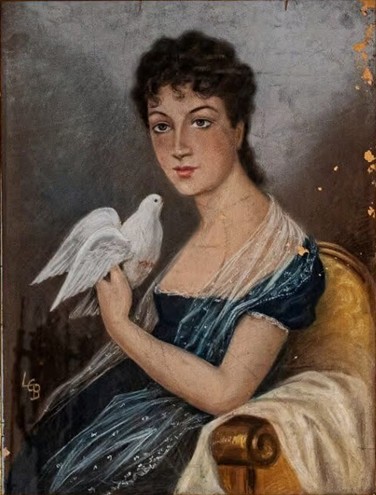
Sophie Caudeiron Vaccà Berlinghieri (House-museum Vaccà Berlinghieri, Montefoscoli, PI)
Works Cited
Clairmont, Claire, The Journals of Claire Clairmont, ed. Marion Kingston Stocking, Cambridge, Mass., Harvard University Press, 1968.
Curreli, Mario, Una certa Signora Mason. Romantici inglesi a Pisa ai tempi di Leopardi, Pisa, Edizioni ETS, 1997.
Del Vivo, Caterina, “La ‘bella Vaccà’”, in Leopardi a Pisa, a cura di Fiorenza Ceragioli, Milano, Electa, 1997, pp. 274-81.
Del Vivo, Caterina, La “Bella Vaccà”, Leopoldo e Andrea. Sophie Caudeiron e i Vaccà Berlinghieri, Pisa, Edizioni ETS, 2009.
Montorzi, Mario, “I Vaccà Berlinghieri: una laica famiglia della borghesia accademica pisana tra scienza, politica e cultura nell’Europa della Restaurazione”, in L’Università di Napoleone. La riforma del sapere a Pisa, a cura di Romano Paolo Coppini, Alessandro Tosi. Alessandro Volpi, Pisa, Edizioni Plus, 2004, pp. 81-91.
Vaccà Giusti, Laura, Andrea Vaccà e la sua famiglia, Pisa, Francesco Mariotti, 1878.
Vieusseux, Giovan Pietro, Leopardi nel carteggio Vieusseux: opinioni e giudizi dei contemporanei, 1823-1837, vol. 2, a cura di Elisabetta Benucci, Laura Melosi e Daniela Pulci, Firenze, Olschki, 2001.
Nicoletta Caputo, December 2025
All the English translations from Italian are by the author of the present essay
Ultimo aggiornamento
22.09.2026