
The Pisan Salons and Literary Academies in the 18th and 19th Centuries
Nicoletta Caputo (University of Pisa)
Although in her comment to Percy’s 1820 poems Mary described Pisa as a “quiet half-unpeopled town” (M. Shelley 1839, p. 279), when the Shelleys settled in the city in January 1820, it could already boast a long tradition of hospitality. This is witnessed by the Casino dei Nobili (Panajia 1996, pp. 209-13), whose foundation had been decreed by the Pisan aristocracy to offer precisely “in the wake of the custom of the Sienese and Florentine nobility […] suitable premises for collective use, for the fulfillment of social obligations towards passing travellers or foreign residents ‘of distinction’” (Panajia 2021, p. 41). Pisa was mainly chosen as a travel destination and as a residence due to “the extreme mildness of the climate” (M. Shelley 1839, p. 279) and the proximity of the Baths of San Giuliano, which had been restored starting in 1742 and attracted the best European aristocracy (Salvetti 1993, p. 6). The Casino dei Nobili opened in 1754, and the new Ballroom was inaugurated in 1788 (Salvetti 1993, pp. 15-20); the venue was also attended by members of the grand ducal family, who usually spent the winter in Pisa, where the climate was milder than in Florence.
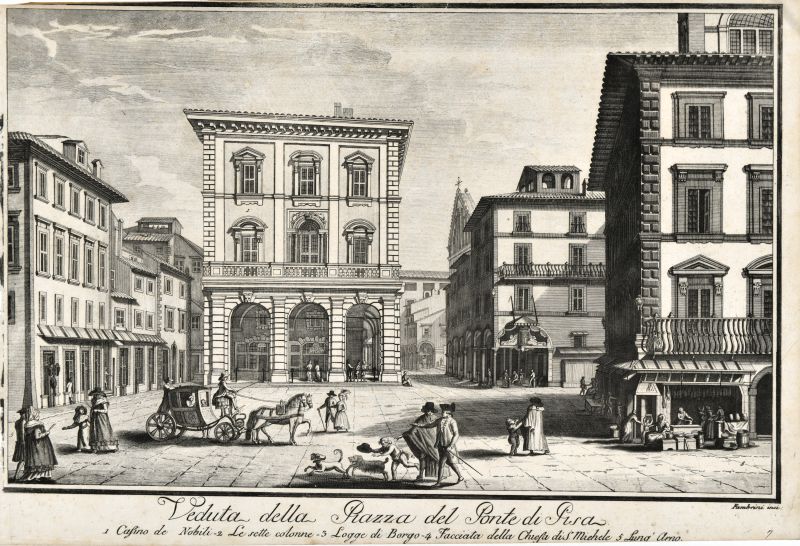
Ferdinando Fambrini, the Casino dei Nobili in the second half of the 18th century ( CC BY 4.0)
Pisa, however, attracted not only aristocrats but also illustrious literati, who tended to rent houses on the Lungarni (as did the Shelleys and Lord Byron) and frequented the Pisan salons and literary academies. In the mid-18th century, Carlo Goldoni arrived, remaining in the city from September 1744 to April 1748 to work as a lawyer (De Fecondo and Timpanaro 2010). In Pisa, Goldoni was welcomed by the men of letters associated with the “Colonia Alfea” of the “Accademia dell’Arcadia” (or “Accademia degli Arcadi”), which he joined under the pseudonymous Arcadia name of Polisseno Fegejo (Curreli 2000, p. 26). Founded in 1700, this colony was one of the twenty-five academies that flourished in Pisa during the 17th and 18th centuries (Agostini and Scarselli 2024). Goldoni was likely also in contact with the circles of Freemasonry.
Next came Vittorio Alfieri, who first visited Pisa in 1776. On this occasion, he only stayed “six or seven weeks” (Alfieri 1983, p. 181), yet he still had time to become acquainted with “all the most illustrious professors” (Alfieri 1983, p. 181) at the local university, including Francesco Vaccà Berlinghieri, the father of Leopoldo and Andrea Vaccà Berlinghieri. Alfieri returned to Pisa eight years later, and remained in the city from November 1784 to September 1785, lodging in Via Santa Maria 36 (at Palazzo Nervi, now Palazzo Venera). He employed as his secretary Gaetano Polidori, the father of John William Polidori (Lord Byron’s physician and author of The Vampyre) and the grandfather of Dante Gabriel Rossetti. Particularly noteworthy, however, is Alfieri’s final and briefest visit to Pisa. He arrived on 16 June 1795 for the patronal feast of San Ranieri to see the “luminara” - which he had greatly admired ten years earlier - and played the title role in his tragedy Saul. The play was staged by a company of young amateur actors at the small theatre inside Palazzo Roncioni, on the Lungarno. He had been invited to take part in this performance by Count Angiolo Roncioni, who had established a cultural circle called the “Roncioni Academy”. As Alfieri wrote in his memoirs, “and there being in Pisa in the private house of some Lords another company of amateurs, who also performed Saul, I, invited by them to go there for the ‘luminara’, had the childish vainglory to go, and I performed only once, and for the last time, my beloved part of Saul; and there I remained, as far as the theatre is concerned, dead as a king” (Alfieri 1983, p. 269).
Count Angiolo Roncioni’s daughter, Isabella, was intensely loved by Ugo Foscolo and served as inspiration for the character of Teresa in his epistolary novel Le ultime lettere di Jacopo Ortis (The Last letters of Jacopo Ortis), published in 1802. Afterwards, Palazzo Roncioni was the residence of Mme de Staël when, between 1815 and 1816, she spent several months in Pisa with her second husband, the young Swiss officer Jean de Rocca. The wedding between her daughter Albertine and Vittorio, Duke of Broglie, also took place at the palazzo on 26 February 1816 (Curreli 1997, p. 20). While in Pisa, Mme de Staël frequented two salons that just a few years later would host the Shelleys - those of Sophie Caudeiron Vaccà Berlinghieri and Elena Amati Mastiani Brunacci - and found the latter “plus agréable que toutes celles de Florence” (Addobbati 2004, p. 78).
During her residence in Pisa, Mary Shelley also frequented the home of an English lady, Emily Charlotte Ogilvie Beauclerk, who had come to spend the winter of 1821-22 in the city with her seven daughters. Her salon was the only private one in Pisa where dance parties were held; Mary attended them accompanied by Edward John Trelawny, who escorted her in place of her husband. Percy Bysshe Shelley abhorred such gatherings, as evident from a letter he wrote to Thomas Love Peacock: “I find saloons & compliments too great bores; though I am of an extremely social disposition” (P. B. Shelley 1964, p. 184). Mary Shelley’s journal also records two visits to the Casino dei Nobili, which occurred on 11 and 23 July 1821, when the Shelleys were staying at the Baths of San Giuliano. Percy and Mary had also been regulars at the Casino of Bagni di Lucca, visiting every Sunday, though, as their journals and letters show, neither Mary nor Claire Clairmont, her stepsister, danced (P. B. Shelley 1964, p. 22; M. Shelley 1987, pp. 217, 219, and 221). This, however, as Mary explained to Maria Gisborne, was simply because they knew no one there: “I do not much like the Casino, since there are no persons that we know there; it would otherwise be pleasant enough. […] I ought to tell you that no English go to the Casino; partly because the festa di ballo is always on a Sunday” (M. Shelley 1980, pp. 75-76).
The Vaccà Berlinghieri and the Mastiani Brunacci salons were likewise attended by Giacomo Leopardi during his stay in Pisa, from 9 November 1827 to 9 June 1828. It was Leopardi who, in a letter to Giovan Pietro Vieusseux, gave Sophie Caudeiron the praising nickname “the beautiful Vaccà” (Vieusseux 2001, p. 528). In 1830 Sophie - whose second husband, Andrea, had died in September 1826 - participated in the collection of signatures organised by the poet’s Florentine friends for a new edition of the Canti, and also promoted some initiatives to support the undertaking (Del Vivo 2009, pp. 183-84). In January 1828, Leopardi was introduced to the Vaccà Berlinghieri household by the Pisan scholar Giovanni Rosini, while it was Lauretta Cipriani Parra - who would later become active in the Italian Risorgimento and marry the patriot Giovanni Montanelli following a romantic liaison - who accompanied the poet to Elena Mastiani Brunacci’s salon. Countess Elena was eager to meet Leopardi; she harboured a deep interest in literature and, in her youth, had attended the "Polentofagi Academy", a name derived from the custom of eating chestnut flour polenta during their literary meetings at the home of the doctor and scholar Francesco Masi in Via Tavoleria. Above Masi’s front door hung a stone coat of arms representing a table with a pile of polenta on it. In Pisa, Leopardi enrolled in the “Alfea Colony” of the “Academy of Arcadia” under the name of Soristo Delfico and entered the “Academy of Lunatics”, choosing for himself the highly ironic name of Giraffe. The latter academy had been refounded in that same year by the Shelleys’ friend Margaret King Moore (known as Mrs Mason), who hosted the meetings at her new home in Via San Lorenzo (Ceragioli 1997, pp. 321-26, and Curreli 1997, pp. 105-120).
Works Cited
Addobbati, Andrea, “La contessa Mastiani Brunacci e il suo salotto”, in L’Università di Napoleone. La riforma del sapere a Pisa, ed. by Romano Paolo Coppini, Alessandro Tosi and Alessandro Volpi, Pisa, Edizioni Plus, 2004, pp. 71-80.
Agostini, Antonio and Alessandro Panajia, eds, Una “privata Conversazione”: l’Accademia Roncioni e Vittorio Alfieri, Pisa, Felici Editore, 2001.
Agostini Antonio and Sergio Scarselli, “L’Ussero: dal Caffè universitario all’Accademia Nazionale di arti, lettere e scienze”, L’Ussero. Rivista di arti, lettere e scienze 11 (gennaio 2024), http://www.usserorivista.it/?p=674 (last accessed 12/122025).
Alfieri, Vittorio, Vita, ed. by Vittore Branca, Milano, Mursia, 1983.
Ceragioli, Fiorenza, ed., Leopardi a Pisa, Milano, Electa, 1997.
Curreli, Mario, Una certa Signora Mason. Romantici inglesi a Pisa ai tempi di Leopardi, Pisa, Edizioni ETS, 1997.
Curreli, Mario, ed., in L’Ussero: un caffè “universitario” nella vita di Pisa, Pisa, Edizioni ETS , 2000.
De Fecondo Giancarlo and Maria Augusta Morelli Timpanaro, eds, Carlo Goldoni avvocato a Pisa (1744-1748), Bologna, Il Mulino, 2010.
Del Vivo, Caterina, La “Bella Vaccà”, Leopoldo e Andrea. Sophie Caudeiron e i Vaccà Berlinghieri, Pisa, Edizioni ETS, 2009.
Montorzi, Mario, “I Vaccà Berlinghieri: una laica famiglia della borghesia accademica pisana tra scienza, politica e cultura nell’Europa della Restaurazione”, in L’Università di Napoleone. La riforma del sapere a Pisa, ed. by Romano Paolo Coppini, Alessandro Tosi and Alessandro Volpi, Pisa, Edizioni Plus, 2004, pp. 81-91.
Panajia, Alessandro, Il Casino dei Nobili. Famiglie illustri, viaggiatori mondanità a Pisa tra Sette e Ottocento, Pisa, Edizioni ETS, 1996.
Panajia, Alessandro, “Casino dei Nobili. Storia e microstorie”, in Il Casino dei Nobili, ed. by Fabrizio Sainati and Alessandro Panajia, Pisa, Edizioni ETS, 2021, pp. 41-72.
Rossi, Giuseppina, ed., Soggiorni e vicende di Vittorio Alfieri a Pisa (1766-1795), Pisa, Tipografia comunale, 1988.
Salvetti, Lucia, Il Casino dei nobili di Pisa nei secoli XVIII e XIX, Pisa, Pacini Editore, 1993.
Shelley, Mary, “Note on the Poems of 1820. By the Editor”, in The Poetical Works of Percy Bysshe Shelley, London, Edward Moxon, 1839.
Shelley, Mary, The Journals of Mary Shelley, vol. 1: 1814-1822, eds Paula R. Feldman and Diana Scott-Kilvert, Oxford, Clarendon Press, 1987.
Shelley, Percy Bysshe, The Letters of Percy Bysshe Shelley, vol. 2, ed. by F. L. Jones, Oxford, Clarendon Press, 1964.
Vaccà Giusti, Laura, Andrea Vaccà e la sua famiglia, Pisa, Francesco Mariotti, 1878.
Vieusseux, Giovan Pietro, Leopardi nel carteggio Vieusseux: opinioni e giudizi dei contemporanei, 1823-1837, vol. 2, ed. by Elisabetta Benucci, Laura Melosi and Daniela Pulci, Firenze, Olschki, 2001.
Nicoletta Caputo, January 2026
All the English translations from Italian are by the author of the present essay
Ultimo aggiornamento
20.09.2026